
Benji Backer, the founder of Nature is Nonpartisan, wants to bring both sides of the US political spectrum together for the good of the planet. It’s not easy.
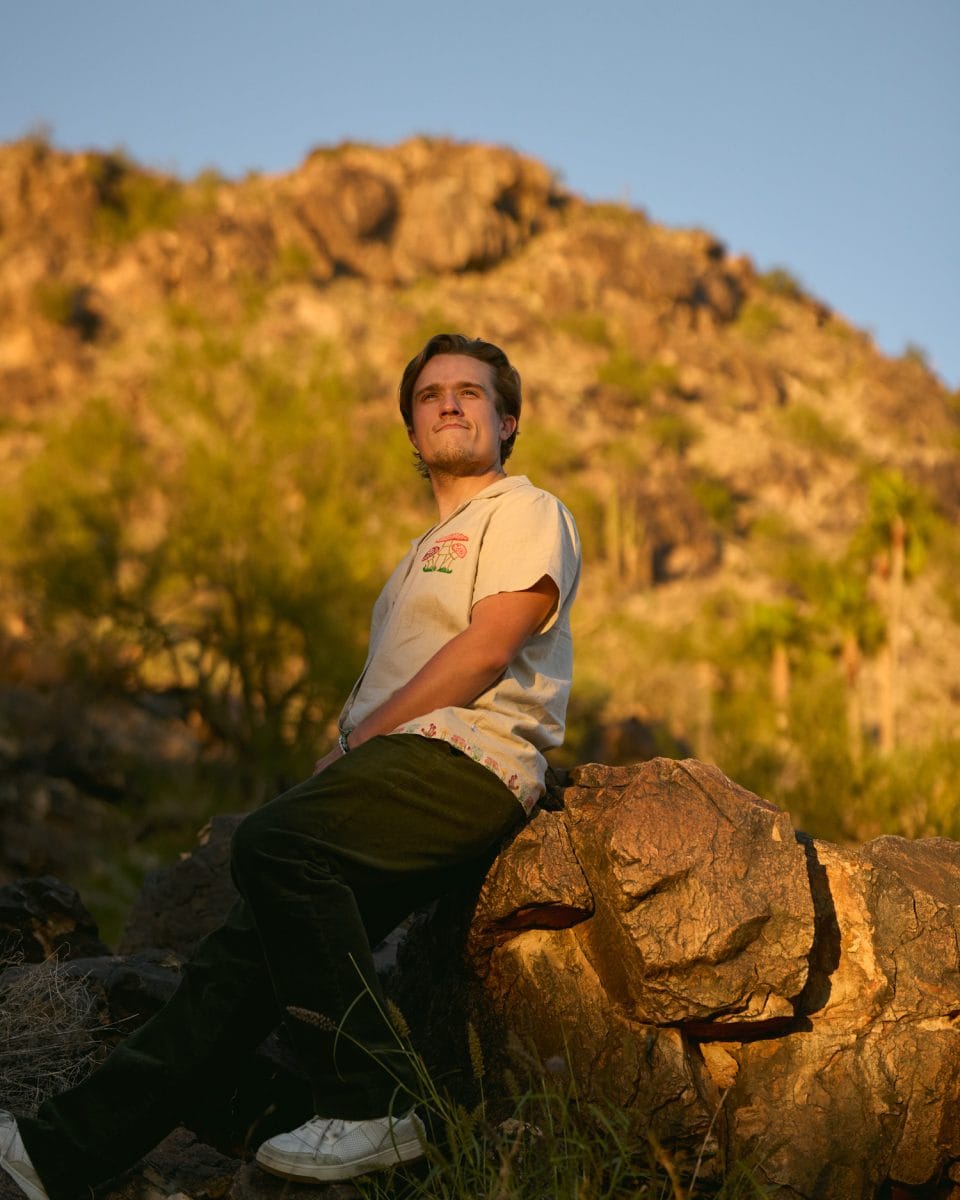
Benji Backer doesn’t look like your typical environmentalist. Clean shaven and square jawed, sporting perfectly coiffed chestnut hair and an immaculate smile, his portrait could go in the dictionary next to “polished”. The 27-year-old American is not the type you’d expect to find hugging a tree or waving a poster at a protest. But he does look like someone who might author a book called The Conservative Environmentalist.
Backer’s 2024 book bemoaned environmentalism’s partisan divide, arguing for an approach to bring rightwingers to the table. He was clear that (unlike many American conservatives) he believed climate change was real and represented an existential threat to life on Earth, but argued that alarmism and partisanship led the movement down the wrong track. “I’m writing [this book] because I’m tired of the tribal approach to climate politics that pits well-meaning people against one another,” Backer wrote.
In the year and a half since the book came out, he has only become more convinced that partisanship is poisoning us. So when I come to interview the ‘conservative environmentalist’, that’s not who I meet.
Backer has shed the ‘conservative’ label, and is, he says, simply an environmentalist.

Backer says his desire to look after nature comes before any political views he holds.
“I had an awakening,” Backer explains. “I realized how damaging the politics of today are. The boxes we put ourselves in are totally worthless. I believe the only way for us to get the action that we need is to step outside polarization. Sure, I have conservative-ish beliefs, and I have liberal beliefs. I believe in capitalism, and I believe women should have the right to choose. My parents are conservative. My sister and my girlfriend are liberal.” But Backer – who was recently named one of Time’s 100 Most Influential Climate Leaders – doesn’t see himself on any side other than nature’s.
That’s the ethos behind his new environmental advocacy group, Nature is Nonpartisan.
“I’m going to work with whoever I can”
The nonprofit aims to bring both sides of the American political spectrum together on four key issues: forest restoration and wildfire prevention, water quality and infrastructure, natural disaster resilience, and land stewardship. On its Our Team page, each staffer’s political label – conservative, centrist, liberal, moderate – has been crossed out, replaced with labels like trail runner, skier, hunter or beach bum. The group’s board members and strategic advisors include a former executive director of the Sierra Club, a Trump-appointed former Secretary of the Interior, and Gen Z social media influencers and podcasters. There are more than a few names on the list – such as Jack Selby, who manages the venture capital fund of billionaire tech mogul Peter Thiel – that will raise some eyebrows.
Backer is unabashed. “If you’re willing to work with me on this issue, I’m willing to work with you,” he says. “I’m going to work with whoever I can.”
Nature is Nonpartisan is still in its infancy – the organization launched in March 2025 – but it has already racked up a few wins. For one, Backer and his team were instrumental in rallying conservatives to block Republican Senator Mike Lee’s scheme to sell up to 3.3 million acres of public land. The proposal was removed after condemnation from both sides of the political aisle. “We used so many unlikely allies across the spectrum,” Backer recalls. “You saw Joe Rogan, big hunting and fishing voices, big conservative influencers, but also Patagonia and all the climate influencers, all standing up for the same thing. That’s the vision we have, and that’s the model we’re going to replicate.”
Look left, look right
If any issue should unite us all, surely it’s protecting the planet we all live on. And yet we’ve allowed our political agendas to become “the biggest barrier to action”, Backer believes.
Surveys show that voters on both sides agree on the importance of protecting the environment, and feel frustrated at politicians’ inability to agree on environmental issues. Green policies such as tree planting and tax breaks for home energy efficiency measures enjoy broad cross-party support.
“The average American that I’ve talked to, wants this to succeed”
“I have to remind myself that Internet trolls are not necessarily speaking for the masses,” Backer says. When out on the road talking to people, “I’m constantly inspired by how much people want this to succeed,” he says. “The NGO community wants this to succeed. The well-intentioned politicians want this to succeed. The average American that I’ve talked to, wants this to succeed.”
Nature is Nonpartisan also spearheaded the formation of the Make America Beautiful Again (MABA) Commission, which President Trump established by executive order, to “build on the legacy of conservative conservationists like President Teddy Roosevelt” to “protect our Nation’s natural treasures”. In October, the organization helped launch the Senate Stewardship Caucus, a coalition of four Democrats and four Republicans – who aim “to drive bipartisan efforts to protect and expand access to public lands, promote commonsense land management policies, and support economic growth in rural communities”.
“I don’t know how people look at the environment and think, ‘Oh, my political identity matters more,’” says Backer, as he looks out of his window at the mountains of Arizona. “I don’t think anyone in their right mind actually believes that’s true. When you’re on a hiking trail or you’re going out hunting or you’re spending time outside, you’re surrounded by people from all different walks of life. You’re telling me that all those people can’t stand together for the same thing?”
The sharpness of political division in the United States became more personal than ever for Backer in September 2025, when rightwing activist Charlie Kirk was shot dead during a debate in Utah. Backer and Kirk were old friends, and as a high schooler in 2012, Backer worked on the launch of Kirk’s organization, Turning Point USA. In a tearful interview with PBS the day after Kirk’s death, Backer spoke about how the older activist supported him at a time when he was receiving threats against his own life. The two later drifted apart, Backer said, and had “very strong disagreements” that went far beyond environmental issues, but he continued to admire Kirk’s willingness to engage with his opponents. After all, Kirk may have stoked division, but it was his determination to take part in open debates that left him open to violence. “We have become so inhumane in our disagreements with one another,” Backer told PBS. “The more that we do that, the more people are going to get killed.”
During our interview, Backer tells me that his time with Kirk gave him plenty of insight into “the game of polarizing people.” “That is not my goal,” he says.
Raising our expectations
In today’s United States, the environment is almost exclusively a left-wing talking point. That wasn’t always the case. The National Park System was established by a conservative president, Theodore Roosevelt. Richard Nixon, another conservative, created the Environmental Protection Agency (EPA) and signed legislation like the National Environmental Policy Act, Clean Air Act, and Endangered Species Act.
The issue today isn’t that the values of political leaders have changed, Backer argues, but that the demands of the public have. “Richard Nixon didn’t actually care about the environment that much,” he admits. “Nixon cared about winning on a popular issue with American voters, about getting good things done because Americans expected it. Where is that expectation across party lines now? That’s what we have to recreate.”
RELATED ARTICLE

So, how did the climate movement lose the right? Backer argues it has been a messaging issue. “It felt anti-rural, anti-energy,” he says. “It told people if you used fossil fuels you were evil. If you were a fossil fuel worker, you were the enemy, you were tearing down the world. People felt vilified, alienated, disconnected.” It also felt alarmist and hypocritical, Backer says. “People thought, ‘This leader is telling me I shouldn’t use fossil fuels, but they’re flying around in their private jet?’”
It will surprise no one to hear that Backer’s movement has taken fire from both sides of the aisle. Leaders on the right have painted him as a pseudo-conservative pushing a liberal agenda, while influential figures on the left have called him a right-wing ‘Trojan horse’, and questioned where he’s getting his funding from. Backer’s donors are private, and he has no intention of changing that, but he claims they’re distributed equally across the political spectrum, are mostly traditional environmental groups, and no single donor is above five percent of his total budget.
“I’m not here to do anyone’s bidding,” he says. “I’m not tied to any political candidate or any party.” To the doubters, he says, “the work will speak for itself”.

The green movement has made a lot of mistakes, Backer believes.
It’s easy to see why Backer’s way of going about that work confounds the expectations of many environmentalists. He tends to downplay the machinations of the fossil fuel industry, and some of his messaging feels remarkably neutered. For example, he spent most of The Conservative Environmentalist discussing climate change and how we should address it. But Nature is Nonpartisan’s public action plan sidesteps the issue entirely. Terms like ‘climate change’ and ‘carbon emissions’ are absent from the organization’s website.
For Backer, this wasn’t a hard decision. “The reality is that Nature is Nonpartisan is all about climate change,” he says. “I obviously believe in climate change, and I believe we need to do something about it. But it’s become a culture war issue in this country. It’s a non-starter. By focusing on natural ecosystems and infrastructure, resiliency, sustainable agriculture, restoring forests, and clean energy, we can have the same impact. We’re still doing everything we can to reduce emissions, but we’re not trying to turn people away.”
As well as dodging the c-word, Backer avoids terms like ‘sustainability’, ‘green’ and ‘eco’. “It’s hard to connect the emotional reality of what people care about to these words,” he says.
“We have to reach people where they’re at instead of telling them what they should care about”
Perhaps the concessions and compromise that come with bipartisan movements will always mean they feel less satisfying than those which come from one side or the other. You don’t get everything you want. If you’re lucky, you get half. However, Backer argues that bipartisan efforts like those catalyzed by Nature is Nonpartisan are also infinitely more enduring. “I’ve really realized the quickest way to prevent the action that you want is to be radical about it,” he says. Under America’s two-party system, one party may pass sweeping policies while they have a majority, but if those policies are voted in strictly along party lines, “guess who’s going to undo them the next time they’re in office? Then what do you have? Nothing. The quickest way to inaction is polarization. People have this perception that the more radical they are, the more they’ll push the needle and the more they’ll get done. That’s just not true.”
One size fits nobody
In Backer’s view, the mistakes that saw the environmental movement lose the right arose from an approach that felt top-down and one-size-fits-all. Climate change is a global issue that requires localized messaging, he argues. “Yes, the Amazon rainforest is critical for life on this planet, but the average person in the US is not thinking about the Amazon when they go to their nine-to-five job, come home, and try to feed their family.”
Backer, who lives in Arizona, says the people in his community “don’t have the benefit of traveling around the world like I do, gaining appreciation for the different issues other communities are having.” Their concerns are specific and local. For example, “They care about air quality. They care about water. They care about droughts and heat waves.” Of course, climate change impacts all of those things, but Backer says activists need to do a better job tying the connective tissue between things like global temperature rise to tangible, local impacts. “We have to reach people where they’re at,” he says, “instead of trying to tell them what they should care about from a global standpoint.”

Spending time in nature helps Backer deal with the pressure he faces in his work advocating to protect it.
He points to conservative leaders, some of whom are climate change deniers, nevertheless taking substantial environmental action in pursuit of concrete regional benefits. Florida governor Ron DeSantis “has put a historic level of funding into Everglades restoration,” he notes. “Georgia governor Brian Kemp is putting more money and jobs into clean energy and EV infrastructure than any state in the country outside of California, because it’s good for his state. It’s not because these guys care about ice caps melting, it’s because it’s good for their state.”
Backer also argues that the environmental movement stumbles when it fixates on identity politics. He’s clear that “environmental [issues] disproportionately impact lower income people,” but he prefers to put the focus on what this group shares, not what divides them. “Everyone who is low income is disproportionately affected by environmental issues,” Backer says. “That’s true whether you’re in Cancer Alley [an area of Louisiana with high levels of pollution caused by chemical plants, and a high proportion of Black residents] or near a coal mining facility in West Virginia [a state that is over 90% White].” Environmental justice advocates can point to the very real effects of decades of racist housing policies on people’s lives today, or show evidence of how almost any marginalized group is more vulnerable to the effects of environmental harm. But for Backer, the question is whether conversations like these help the movement, or just create more division.
A lonely path
Backer works long hours and spends most days on the road, fundraising, speaking, touring project facilities, and advocating in Washington DC. He says the role he’s chosen – standing in the middle and trying to bring both sides together – is isolating. “The more I’ve become active in fighting for nature, the less time I’ve spent in it,” he admits. He smiles, then adds, “You can usually tell how long it’s been since I’ve been in the mountains by my anxiety levels.”
It’s true that he seems anxious (perhaps no surprise, given that we’re speaking only a few weeks after the death of Charlie Kirk). He tells me he feels eyes are on him constantly, waiting for him to slip up. “Both Republican and Democratic leadership are watching what I’m saying,” he says. “They’re looking for ways to say, ‘This is our enemy. He’s secretly a liberal,’ or ‘He’s secretly a Trump guy.’”
“If I had ulterior motives, I’d be doing something very different”
Amid one of the most polarizing eras in modern US history, and one where social media algorithms prioritize conflict, Backer is up against long odds promoting the middle ground. “It’s been lonely,” he admits. “It’s hard to prove that you don’t have some ulterior motive in a time when everyone assumes that you must. Honestly, it’s painful sometimes, because the truth is, this is literally all I care about.”
“We all know how easy it is in today’s world to stoke division and pit people against each other,” says Backer. “If I had ulterior motives, I’d be doing something very different than trying to bring both sides together for the environment.”
When the dust settles
And so to the elephant in the room: how does Backer feel about Trump? This is the president who calls climate change a con job, and who, as one of his first presidential acts, walked out of the Paris Agreement. In his second term he has so far fired thousands of employees from the National Park Service and Forest Service, opened up Alaska’s wildlife refuge for oil drilling, and walked out of the Paris Agreement – again.
Backer chooses his words carefully. “I’m an environmental conservationist, I’m a steward, a nature lover, whatever you want to call it, way before my political beliefs,” he says. “Does that mean I don’t care about politics? No.”
Could the country have chosen a more “pro-environment” presidential candidate, Backer asks rhetorically. “Probably,” he concludes, in a rather unsatisfying answer to his own question. But if we take him at his word, it’s not timidness that keeps him from coming off the fence. It’s clarity of purpose. He’s here to help the environment, he says, and he’ll “do whatever it takes to get that done”.
That imperative of ‘getting stuff done’ is why everything Backer says about this administration has to be seen in the light of how Donald Trump responds to being criticized. You can speak truth to power, and you can work with those in power. But there’s a long list of people who would testify that, when it comes to Trump, you can’t do both. So, given the challenge Backer has set himself, it can be hard to know when he’s speaking from a place of passion, and when he’s speaking from a place of pragmatism. Maybe it’s the same place.
Backer says: “People [on the left] will get upset with me that I’m not just hating on Trump all the time. And then people in the Donald Trump world will get upset that I’m not applauding him all the time. But when the dust settles after an election, do you throw your hands up when somebody you didn’t like won, or do you keep pushing forward? I don’t care if I give credit to Democrats or I give credit to Republicans… Like, who gives a flying fuck? I truly don’t care if someone voted for Trump or Harris when it comes to working with them on this issue. I don’t care if their name is Kamala Harris or Donald Trump. I’m going to work with them on this issue, if they’re willing to have that conversation.”

Cover star Madame Gandhi on the sounds of the Antarctic, free climber Alex Honnold reveals his biggest challenge yet, actor Rainn Wilson embraces his soulful side and much much more!